
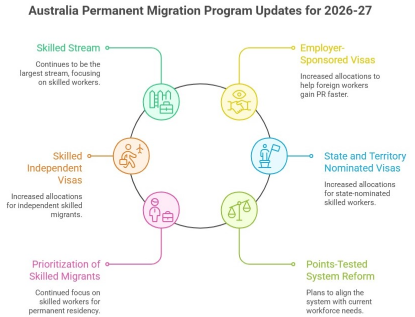
The Australian migration landscape is experiencing significant shifts as the Department of Home Affairs continues to modernize its visa programs and align them with broader national economic priorities. Navigating the Upcoming Changes to Australia’s Visa System is essential for anyone looking to build a sustainable future in Australia, whether you are an international student, a skilled professional, or an employer looking to sponsor global talent. The government’s 2026-2027 migration strategy places a pronounced emphasis on integrity, sustainable population growth, and direct transitions to permanent residency for individuals already contributing to the Australian community.
For prospective students and international professionals, managing these updates requires a proactive approach. Working alongside certified study abroad consultants can provide clarity on genuine student requirements, while seasoned educational consultants highlight the necessity of choosing courses aligned with long-term economic demands. In this comprehensive guide, we unpack the latest legislative updates, the 2026-2027 migration planning levels, university enrollment frameworks, and what these changes mean for your pathway to Australia.
Strategic Shift in the Permanent Migration Program
The Australian Government has set the 2026-2027 Permanent Migration Program planning level at 185,000 places, sustaining the program’s overall size while executing a major structural pivot toward onshore visa holders. Under the updated framework, the program maintains a balanced division between the Skilled stream and the Family stream. However, the standout feature of this period is the allocation of 129,590 places specifically for onshore applicants.
This deliberate focus on onshore transitions acknowledges the significant economic and social contributions of temporary visa holders who have already settled, worked, and established roots within Australia. By prioritizing candidates currently working in critical sectors, the government aims to fulfill persistent domestic labour demands while moderating the broader pressures on housing and urban infrastructure associated with net overseas migration.
Additionally, the Department of Home Affairs has finalized the replacement of legacy talent pathways with the streamlined National Innovation Visa. This single, cohesive visa pathway is tailored specifically for exceptionally talented individuals, high-caliber entrepreneurs, and pioneering researchers who can drive technological and industrial innovation across Australian enterprises.
Key Drivers Behind the Upcoming Changes to Australia’s Visa System
For skilled workers and sponsoring businesses, several significant financial and regulatory adjustments have come into effect. Staying ahead of the Upcoming Changes to Australia’s Visa System ensures that both applicants and sponsors remain fully compliant with Department of Home Affairs regulations.
1. Updated Income Thresholds (TSMIT Indexation)
To safeguard domestic wage standards and ensure that sponsored international workers receive equitable remuneration, the Temporary Skilled Migration Income Threshold (TSMIT) has been indexed to $79,423. Sponsoring employers must guarantee that any candidate nominated under temporary skill shortage pathways meets or exceeds this minimum salary baseline, alongside complying with the Annual Market Salary Rate for their specific geographic region.
2. Revision of Visa Lodgement Charges
In line with expanded administrative and verification procedures, government visa application charges have been revised upward. The fee for primary applicants under the Employer Nomination Scheme (Subclass 186) currently stands at AUD 6,140, while the base fee for temporary skilled visas is AUD 4,015. These financial updates require prospective migrants and employers to carefully budget their visa acquisition strategies well in advance.
3. Heightened Sponsor Compliance and Worker Protection
The Department’s specialized monitoring units have expanded their oversight to eliminate exploitative employment arrangements and deceptive recruitment practices. Sponsoring organizations are subject to systematic audits, and strict sanctions are enforced against entities that attempt to underpay or place unlawful restrictions on sponsored personnel.
Higher Education Reforms and National Planning Levels
International education remains one of Australia’s most vital export sectors, but the 2026 framework introduces structured controls designed to manage quality and institution-level growth. The government has established the National Planning Level (NPL) at 295,000 international student commencements across universities and vocational institutions.
The NPL operates primarily as an administrative prioritization tool rather than a rigid total closure. Once an educational institution approaches its designated commencement allocation, subsequent offshore visa applications directed toward that institution experience adjusted processing timelines. To maintain fairness, specific exemptions apply: students progressing into higher education after completing senior secondary studies in Australia, as well as students entering from approved TAFE pathways, do not count against an institution’s base NPL cap.
In response to these mechanisms, leading study abroad consultants advise applicants to secure their university placements early in the calendar year. Furthermore, universities that invest directly in purpose-built student accommodation facilities are eligible to apply for expanded student intake limits. Consequently, experienced study abroad consultants emphasize looking into regional universities that offer expanded accommodation quotas, which frequently results in more streamlined visa processing outcomes.
The Value of Strategic Academic and Career Mapping
Navigating the evolving visa framework requires selecting an academic pathway that reflects genuine labour market needs. Working with certified educational consultants ensures that your academic history meets the stringent verification tests applied during the visa assessment process.
The Australian Government consistently prioritizes skilled applications in essential sectors such as healthcare, nursing, civil infrastructure, and early childhood education under updated Ministerial directions. Knowledgeable educational consultants frequently assess how institutional caps affect offshore processing speeds, helping students select accredited courses that maximize their eligibility for post-study work rights and subsequent employer sponsorship.
Before finalizing course selections, professional educational consultants strongly recommend focusing on accredited qualifications in critical shortage areas. Coordinating with certified study abroad consultants helps bridge the gap between academic graduation and sponsored employment, ensuring that all work experience requirements are documented in accordance with Department standards.
2025 vs. 2026-2027 Policy Framework Comparison
To provide a clear, scannable overview of the core shifts between previous standards and the current financial year, the table below summarizes key regulatory metrics:
| Migration Metric / Policy Area | Previous Policy Baseline | Current 2026-2027 Framework | Primary Impact on Applicants |
| Permanent Migration Ceiling | 185,000 total places | 185,000 total places (129,590 reserved onshore) | Unprecedented advantage for skilled workers already living in Australia. |
| Minimum Sponsored Salary (TSMIT) | $76,515 per annum | $79,423 per annum | Higher guaranteed minimum earnings for sponsored professionals. |
| Temporary Skilled Visa Base Fee | AUD 3,210 | AUD 4,015 | Higher initial investment required for employer-sponsored applications. |
| Permanent Residency (Subclass 186) Fee | AUD 4,910 | AUD 6,140 | Increased financial preparation needed for transitioning to PR status. |
| National Planning Level (Students) | 270,000 commencements | 295,000 commencements | Growth in overall capacity paired with institutional allocations. |
| High-Tier Innovation Pathway | Global Talent / BIIP Visas | National Innovation Visa | Streamlined single program for exceptional global innovators. |
Essential Best Practices for Visa Applicants
To ensure your visa application progresses without administrative delays, all prospective applicants must account for the Upcoming Changes to Australia’s Visa System when submitting formal applications. Implementing the following steps will significantly strengthen your migration journey:
- Maintain Complete Documentation: Ensure all employment contracts, payslips, tax assessments, and official skills evaluations are organized and up to date.
- Verify Institution Compliance: Prior to enrolling in an academic program, confirm that your chosen educational provider holds adequate allocation limits under the current National Planning Level.
- Engage Accredited Representatives: Always verify the registration details of any advisor you consult. Trusted study abroad consultants remain an invaluable asset for verifying documentation integrity, while consulting with qualified educational consultants ensures you make informed decisions every step of the way.
Summary
The ongoing evolution of the Australian migration framework highlights a clear government objective: fostering a transparent, high-integrity system that values onshore contributions, protects workplace rights, and aligns education with real-world industry requirements. By understanding the operational thresholds, fee adjustments, and institutional planning limits, applicants can successfully position themselves for a seamless migration pathway to Australia.
One Response
Your method of telling all in this article is actually nice, every one be capable of effortlessly understand it, Thanks a lot.
Someone necessarily help to make significantly posts I might state. This is the very first time I frequented your web page and up to now? I amazed with the analysis you made to create this actual post extraordinary. Fantastic task!